

Strategy vs. Tactics:
Why most small
business marketing
fails before it starts
business marketing
fails before it starts
Most businesses don’t have a marketing problem. They have a strategy problem that shows up wearing a marketing costume.
I’ve spent almost 30 years watching companies chase the same fix: a new logo, a new website, a new ad campaign, a new agency. And almost every time, the real issue was never the execution. It was that nobody had answered the harder question first — who exactly are we trying to reach, and what do they actually need to hear from us?
"Most businesses don't have a marketing problem. They have a strategy problem that shows up wearing a marketing costume."
— Meg Dubbs, MD Marketing & Design
It’s a blunt way to put it, but it’s rarely far from true. Most small businesses skip straight to tactics because tactics feel like progress. A new Instagram account feels like doing something. A rebrand feels like momentum. But if the strategy underneath is missing, you’re just producing louder noise, not better results.
Strategy Answers Questions Design Can’t
Before a single graphic gets designed or a single ad gets written…
These 3 questions need real answers:
- Who is your actual buyer?
- What problem are they trying to solve when they find you?
- And why should they believe you’re the one to solve it?
Skip these, and even beautiful creative work ends up talking to no one in particular — which, in practice, means it talks to everyone and lands with no one.

Consistency Is a Trust Signal, Not a Style Preference
I’ve watched businesses treat brand consistency as a nice-to-have — something for when there’s budget left over. But inconsistency has a cost: it quietly tells a prospect that if you can’t keep your own story straight, you might not keep other commitments straight either.
Consistent brand voice and visual identity aren’t about looking polished for its own sake. They make a stranger feel safe enough to become a client.
Marketing and Sales Have to Agree on the Target
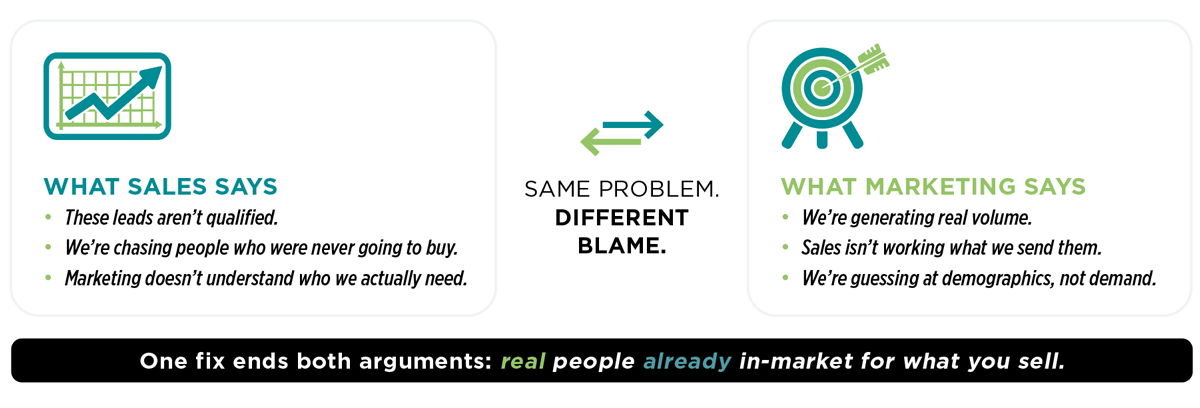
This is the one I’ve seen derail more companies than any creative misstep: marketing generating leads sales doesn’t want, and sales blaming marketing for leads that were never wrong to begin with — just never defined the same way twice. When strategy comes first, both teams are working from the same definition of a qualified buyer, and the finger-pointing has nowhere left to live.
None of this means tactics don’t matter. Good design, sharp copy, and smart campaigns absolutely move the needle — but only once they’re built on a strategy that actually knows who it’s talking to.
Meg Dubbs is the founder of MD Marketing & Design, helping businesses align strategy, design, marketing, sales, and technology to scale with purpose and clarity.